
Grizelda Sarria does a lap around Field 11 at Tukwila’s Starfire Sports complex. Like all the other fields at Starfire on a weeknight, it is packed with teams training. But unlike the other fields, on this one, you can hear Spanish being spoken by players and the parents on the sideline.
“Hola, ¿cómo están?” Sarria asks some parents. She makes small talk about the games coming up this weekend.
Sarria is co-founder and director of Dragons FC, a soccer club whose motto is “community-based, competitively focused.”
Dragons FC’s players and their families are overwhelmingly non-white and either immigrants or first-gen. For a bunch of reasons – from finances to discrimination – these folks have faced difficulties participating in competitive youth sports.

As a largely Hispanic club, Dragons has experienced racism from other teams, and more recently the fear of ICE. But these challenges also contribute toward making Dragons such a tight-knit community.
A 2022 study from the Aspen Institute found that families spent almost $1,200 on one season of club soccer. In comparison, families paying for one season of football only spent half that, mainly because they don’t pay for club expenses.
“We never want to turn away a player because of costs,” Sarria said.
That core tenet sets Dragons FC apart from other clubs. Unlike recreational teams, club soccer expectations are stricter with more practices, a higher level of competition in games, and it offers a pathway to play in college.
Dragons FC coach, Danny Robles, who plays for the Seattle Sounders’ second team, the Tacoma Defiance, grew up in Burien and was raised by a single mom who couldn’t afford club soccer.
“I was fortunate enough to have people who gave me all that opportunity, but there’s kids in my community who were as good as me, but just didn’t have that support from other people,” Robles said. “I think Dragons FC is kind of filling that space in between, whether you want to make the jump from rec soccer into something more competitive.”
Robles recalls his own experience in the youth system and how difficult it was to navigate the landscape without any prior knowledge. It was only because other parents told him about it that he tried out for a club team, and from there was scouted to play for the Sounders Academy.
“There’s so many leagues now and so many divisions, even from when I was playing, it’s so different,” Robles said. “You have leagues like the EA, you have MLS Next, and then there’s tiers below that.”
“It definitely shaped me and who I am as a person, not just like a player on the soccer field. But I think being grateful and humble are two of the most important things I think I was taught.”
Like Sarria, Robles tries his best to help guide his players and their families through the often complex landscape of youth soccer. This fall, he took his U15 girls team to watch Highline College’s women’s soccer team compete in their league championship against Spokane Community College.
Highline is based in Des Moines and more than half of its students are first generation. The student population is also overwhelmingly non-white which is reflected in their soccer team. Of their 22 person roster, 14 have Hispanic last names and eight or nine players were recruited from Dragons FC. In contrast, Spokane’s team was almost entirely white.
“We wanted to support the coach, because he’s a close friend of mine, and also the girls that played for Dragons, but then also show some of the younger generations that college is a possibility,” Robles said.
Highline lost the game, but Robles used the opportunity to ask his players if they thought they could play at that level.
“Some of them looked at me and were like, ‘Yeah, I think I can,’ and some of them, just like, looked at me and didn’t really say anything, because maybe that question was never asked to them,” he said. “They don’t even know how to process it; maybe no one in the family went to college.”
The higher demands and opportunities in club soccer is reflected in the cost to play. Southlake FC is based in Tukwila and offers a recreational program for $155 a season. In comparison, participation in PacNW, a club also based in Tukwila, costs $3,300. Dragons FC charges $1,600 and offers families payment plans and fundraising is an integral part of each team’s season.
Leila Horejsi manages her daughter’s team at Dragons and helps out with the club’s fundraising efforts.
“We will sometimes do a pop-up at different tournaments, and we’ll sell sodas and chips, coffee in the morning, and donuts,” Horejsi said. Teams have run car washes, taken over a restaurant, and raffled off whatever they can to raise money.
Like Sarria, Horejsi is a daughter of immigrants. Today, she’s a successful businesswoman, but growing up in South Seattle she witnessed the challenges of navigating a new country with young kids.
“You may not know where to go to seek information or access, you may not feel confident or comfortable asking questions, because English is a second language,” Horejsi said.
Haley Teofilo is Sarria’s middle child. Like her sisters, she started out playing soccer at Dragons FC and remained with the club until she graduated. She just finished her first season with the women’s soccer team at Seattle Pacific University.
“It definitely shaped me and who I am as a person, not just like a player on the soccer field,” Teofilo said, mentioning discipline, hard work, drive and some fearlessness. “But I think being grateful and humble are two of the most important things I think I was taught.”
Teofilo described how her parents put themselves through school. Her mom is a civil engineer, and her dad owns his own business. Growing up alongside teammates who had to help take care of their siblings and help their parents work gave her an understanding of why Dragons is so important.
“I think that’s why soccer was also such a great outlet for them as well, because that’s where they can feel like they’re little kids,” Teofilo said.
Coach Robles brought up a childhood friend who passed away from gun violence a few years ago.
“I have some friends who are, you know, in jail and just maybe, if they had something like soccer to escape and to look forward to, then, who knows, maybe things would have been different,” he said. “I had offers to coach at different clubs, but at the end of the day, if I can help my community and help the level of soccer grow, and help the players that went to the same middle school or high school as me grow, I’m going to take the opportunity every time of the week.”
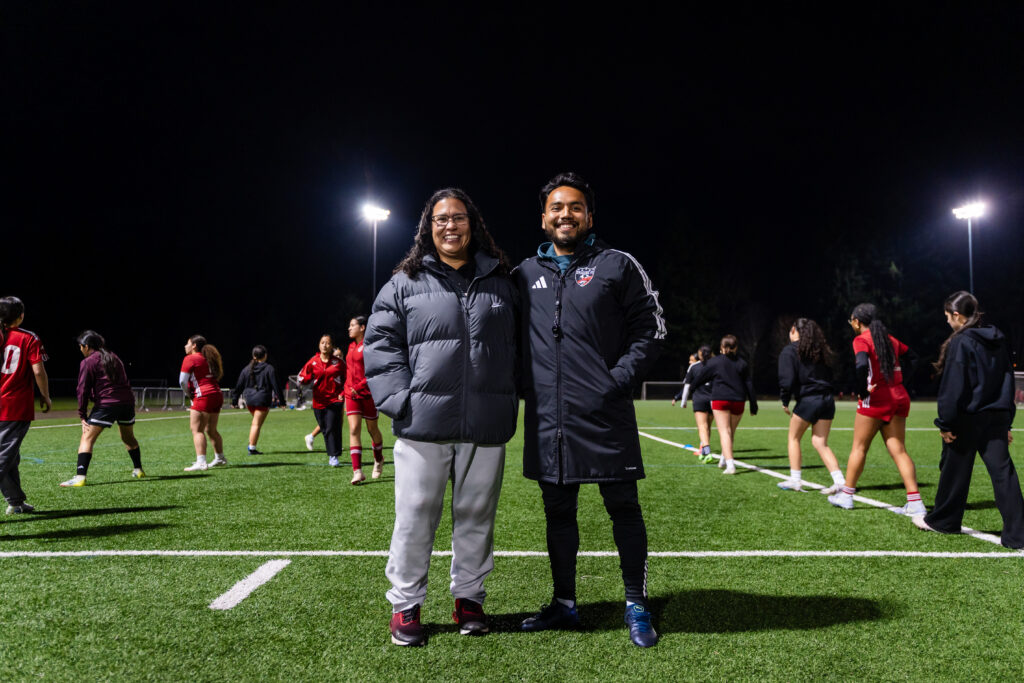
overseeing warm-ups for the 2011 and 2012 Girls team. (Photo by Patty Tang)
This story is co-published with the South Seattle Emerald, a BIPOC-led, nonprofit media outlet.
