
Salem Lemmon has been going to Rain City Soccer Club’s Sunday Kickabouts long before living in Seattle.
“I didn’t even unpack my first weekend, screw unpacking. I went to go join Kickabout because of my memory about it,” they said.
The Capitol Hill-based club has been around since 2000 with a mission of providing Seattle’s LGBTQ+ community opportunities to play soccer. Kickabout has been going on for more than 20 years and is one of Rain City’s flagship programs.
“There’s no barrier of entry, no donation required, no membership required. Any level, any gender can play any amount of soccer that they want to, and it is open to everyone, whether they are queer or not,” Lemmon said.
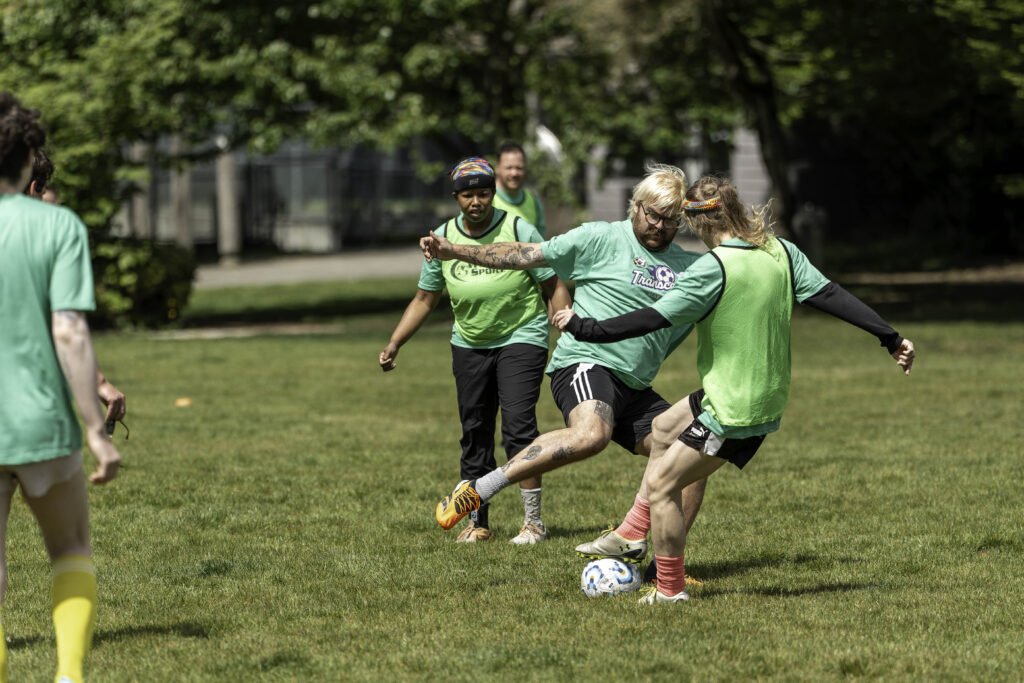
Lemmon is the outgoing president of Rain City. They emphasized the club’s motto, “community first, soccer second.” The purpose of these weekly games isn’t to have ESPN-worthy moments – it’s great if they do. But that’s not the point. For many of these Sunday players, it’s a time when they can be themselves in a setting that has often left them out.
“Kickabout is that larger conversation of how do I create a safe space for people and allow it to be a platform to create change for other people who come out and go, ‘I didn’t know that this could be queer soccer’,” Lemmon said.
That was the case for Connor Dalton who is the new incoming president of the club. When they started going to Kickabout two years ago, they weren’t out yet.
“Rain City was a large part in me coming into my identity,” they said. “Seeing different generations of queer people, getting to experience that is really cool.”
Rain City challenged what soccer could be – how it did not have to be an ultra-competitive environment driven by gender and winning. It could be focused on community and acceptance.
June Moss started to come to Rain City and Sunday Kickabouts during the early stages of their transition, which like Dalton, meant they were adjusting to a new identity and how the world perceived them.
“I’ve met some of my best friends here in Seattle through Rain City Soccer,” they said. “When I was first starting out, I didn’t have insurance at the time and I had some people who steered me in the right direction for getting started on estrogen without having to go through insurance providers,” they said.
For both Moss and Dalton Rain City provided them a safe space to feel like themselves but also community and with it, support in navigating their own gender and sexuality.
“Even when no one is paying attention, it feels like there’s so many eyes on you at all times. And it doesn’t feel like that when I’m playing with Rain City,” Moss said. “I feel like so many people were so welcoming and so nice to me at a time when I really desperately needed to be welcomed and accepted.”
Rain City was a large part in me coming into my identity. Seeing different generations of queer people, getting to experience that is really cool.”
Non-binary athletes in co-ed sports
On Feb. 5, President Trump issued the “Keep Men Out of Women’s Sports” executive order, which rescinded federal funding from any educational programs that allow transgender women and girls to participate on female teams.
In Washington state, an amendment put before the governing body for middle and high school athletics proposed a rule change that would prohibit trans girls from competing in girls sports and create another open division for trans students to compete in instead. That amendment failed by just one vote. However, even if it did, the WIAA said the amendment violated state law and it would not have been implemented.
Despite the state making it clear they will protect the rights of trans athletes as much as they can on the ground, people have to navigate a very binary world on a day-to-day basis. In co-ed rec sports that can be challenging.
Jodie Makara, who uses ze/zir pronouns, also grew up playing soccer but stopped in college due to other priorities. Ze came out as trans in college and navigating the space of a gendered soccer league was not something ze were ready to do. And when Makara did, ze still found it difficult and a challenge that deterred them from consistently playing.
“It actually was more dysphoria inducing trying to play with men because they still saw me as more femme, even though that’s not how I identified,” Ze said.
Makara found zir way to Rain City. And thanks to the club, found a space in which their trans-ness was not questioned, where their proper pronouns were used, and where the idea of any “gender” rules for a team were ignored.
“It’s really brought me back to my roots of playing soccer that I haven’t got to play in years,” Ze said.
Rain City’s teams play in the Recreational Adult Team Soccer (RATS), a league with divisions for men, women, and co-ed teams to play in a casual manner. According to RATS rules, in co-ed games, the distribution is six males and four females.
Ryan Souto plays on a Rain City team in a RATS co-ed league called Red Scare. The team throws out the gender rules which for the most part, hasn’t caused a problem in the league.
“We show up and we say we don’t play gender, you sub whoever you want at all times, and then it’s usually the other team being like, ‘Huh, what? That’s kind of weird, we could play like all of our men?’, and we’re like, yeah, if you want to play all of your men and just ignore all your women go ahead, that’s your decision to make,” they said. “Usually, nine out of 10 times it is totally fine.”
According to Souto, the refs and league have been generally supportive of the team. But sometimes a ref will gender players incorrectly or opponents will take issue with the team’s decision to ignore the gender rule. Souto says their team’s captain communicates with the league when these incidents occur, and they work together to avoid the same issues in the future.
Makara pointed out how powerful it was for Rain City teams to be present in the league.
“I was someone who needed to see other people that looked like me playing for me to feel comfortable playing,” Ze said. “Getting to play with these people, it just feels so so empowering.”
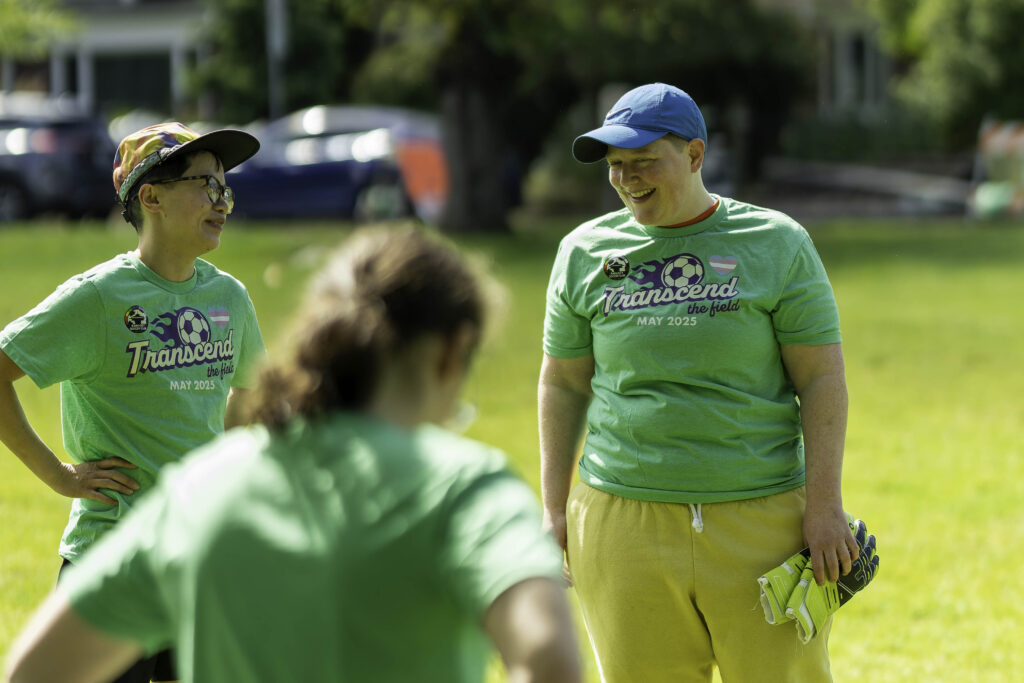
Transcend the Field
In 2023, the first year Lemmon took over as club president, they introduced a new program, “Kicking Out Transphobia.” Like the weekly Kickabouts, KOT invited all skill levels to come out for a scrimmage, but this particular game was limited to those who identify as nonbinary. KOT originally started in Philadelphia by another queer soccer club but this year, Rain City is morphing the event into its own, “Transcend the Field.”
“Transcend the Field is foremost and primarily reparative. It’s the kids’ soccer that none of us ever got to play,” they said.
Unlike KOT, Lemmon doesn’t charge a registration fee for players and the game isn’t tied to any tournament or event that would pull trans players away.
“All of our spaces that we create are also engineered to challenge the norms of soccer so that other people might change,” Lemmon said. “I don’t necessarily need to be more open-minded, I need other people to also realize soccer is a space for me as well.”
“Transcend the Field” is held the same weekend as Rain City’s “Friendly Tournament,” which showcases the club and its athletes over a weekend of games at North SeaTac Park. Any money made from that tournament is used to fund next year’s “Transcend the Field” match which was held at Montlake Playfield this past year.
On Sunday morning, Lemmon gathers the 20 participants to explain the parameters for the match. These include no offside, no counting of goals, an emphasis on passing to everyone, and above everything else, to have fun.
“We’re big on inclusive language here,” they said. “All of us here know and have lived an experience of taking up spaces in other places with other people who aren’t as inclusive as an idea.”
Instead of using the typical term “man on” when telling a teammate another player is pressuring them, Lemmon suggests using “one on” or “one behind.”
“The focus is inclusivity and giving people space and time,” they said.
Players introduced themselves with their first name and pronouns and the group split into two teams.
Ella Hicks had not played with Rain City before the match. They grew up playing soccer, but struggled to find a way back into the game that felt right.
“You have the co-ed option, which usually ends up being mostly cis men, or you have like the women’s option, but this specific event, I was like, oh, my goodness, it’s perfect,” they said.
There’s no ref, players call their own fouls. If someone takes a tumble, a hand is immediately offered to get them back on their feet.
“Transcend is the definition of community for soccer,” Lemmon said.
This match offers a rare space for trans and non-binary folks, somewhere they don’t have to explain themselves or the rest of the world.
“There is no escape from our political climate. But I think Transcend the Field is really a place to center playfulness and fun and just celebrate each other as individuals and also as this sort of group,” Julia Sullivan said.
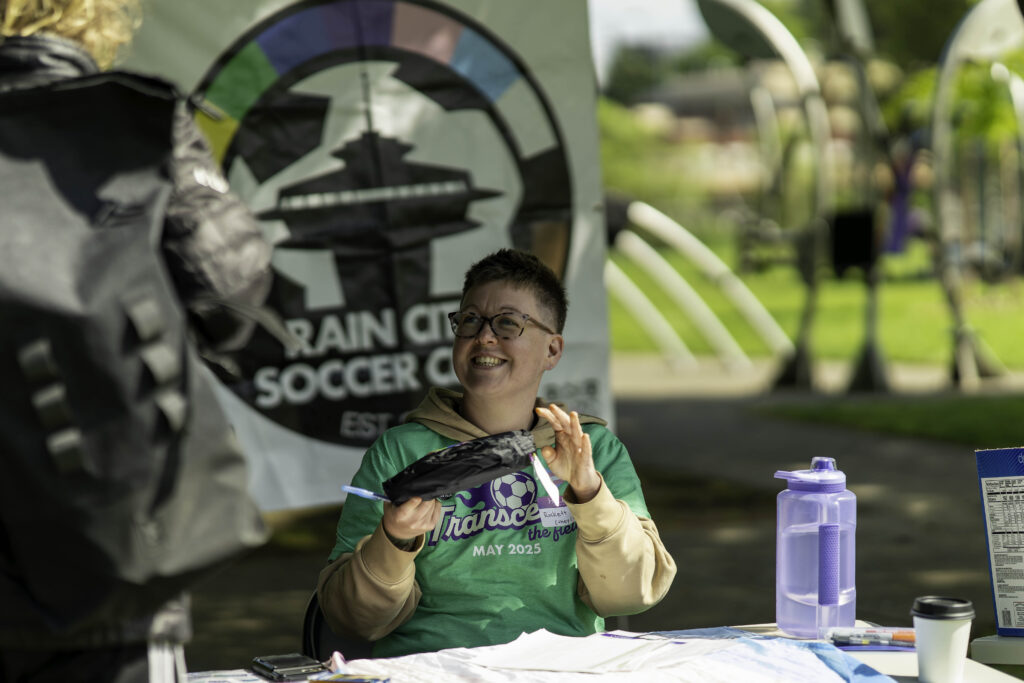
Rain City players said that often their time on the field is the only time they feel like they can be truly themselves. (Photo courtesy Rain City Soccer Club)
Rain City in the landscape of Trump
Lemmon remembers the night of the 2024 election. Emails and messages came pouring in through the club’s Discord and Instagram, expressing disbelief and helplessness.
“The same question I kept getting all the time is, can you give me hope? Can you help me feel grounded?” Lemmon said.
Their answer for them was simple: This too shall pass.
“At a day and time when everyone is shell-shocked, I’m seeing 200 people having a collective conversation of what can we do to protect each other and show up for each other,” Lemmon said. “It’s a community enveloping each other rather than lashing out.”
Members of the club shared resources for legally changing their names, advice for coming out to their parents, and what representatives they could call to make their voices heard.
As a small nonprofit, it’s always been an uphill battle to offer all the programming that Rain City does.
“We try as an organization to do a lot with a little,” Lemmon said. “This year is our highest year for financial assistance requests for the Friendly tournament.”
Looking ahead to the next three years, Lemmon knows things aren’t likely to get better in terms of funding or the need for financial assistance.
“This year was going to be the first year we were going to be a 501c3, where we could apply for grants and in January before he even took office, the first thing Trump said was that he was going to shut down grants for anything that didn’t align with conservative values,” they said.
But despite all that, Lemmon defers back to what they told all the players of Rain City back in November. This will pass and the club will be there to support them – community first, soccer second.
