Pick-up is a ritual. It welcomes people in whatever form they’re in to set aside the hats they wear to work or at home. Tomorrow’s worries vanish in the midst of tackles, sweat, and of course a little trash talk.
These games aren’t played for trophies. There are no points awarded for wins or ties. There aren’t any refs either. Sometimes the pitch is dirt. Other times it’s a small patch of grass. The goals might be regulation size, and if they’re lucky, they’ll have a net.
But none of that matters because it’s pick up.
You play for the love of the game. For bragging rights that week. You play to take your mind away from the worries of tomorrow.
Like any good game, there are house rules. Ten push-ups for a nutmeg, no slide tackling (unless it’s against ‘X’), losers buy the post-game beers. These weekly games become a constant in a world full of the unknown. They’re a temporary refuge.
This column is about these groups. Shining a spotlight and offering a snapshot of the games that go unseen by everyone else but mean the world to those on the pitch.
When Amador Abreu moved to Seattle from Brazil in 1997 for a job at Microsoft, he found himself in an unfamiliar city surrounded by people he didn’t know. What he did know and love was soccer.
Three years later, Arena Sports in Redmond opened with indoor turf fields and public soccer leagues.
“I went there, and I played one night, and I was so happy to play and then I talked to my friends in my work and the Brazilian friends that said, let’s make a team,” Abreu said.
Abreu’s team won enough to move up to a more competitive league, but the intensity also increased. They were competing with younger, fitter players, and the games would sometimes start as late as 10 p.m.
“It wasn’t fun anymore,” Abreu said. “And for three years, I fought with that, until we almost quit, but we had this idea, let’s just not quit. Let’s just rent the field and play against ourselves.”
So that’s what they did.
For the past 20 years, Abreu and his group, the “Wooden Legs,” have had a standing field rental at Redmond’s Arena Sports at 7 p.m. every Friday. Unlike the league, this group was there to have fun.
“There’s some good people, really good and fit, and there were some average people, but the great majority were not really good,” Abreu said.
That’s how the group got its name, “Wooden Legs.”
“One of the things we say when we refer to someone that doesn’t play good soccer, we call them ‘peg legs,’ like this guy’s a peg leg, right? He doesn’t flex,” Abreu said. “In Portuguese, we say ‘perna de pau’ which is ‘wooden leg’.”
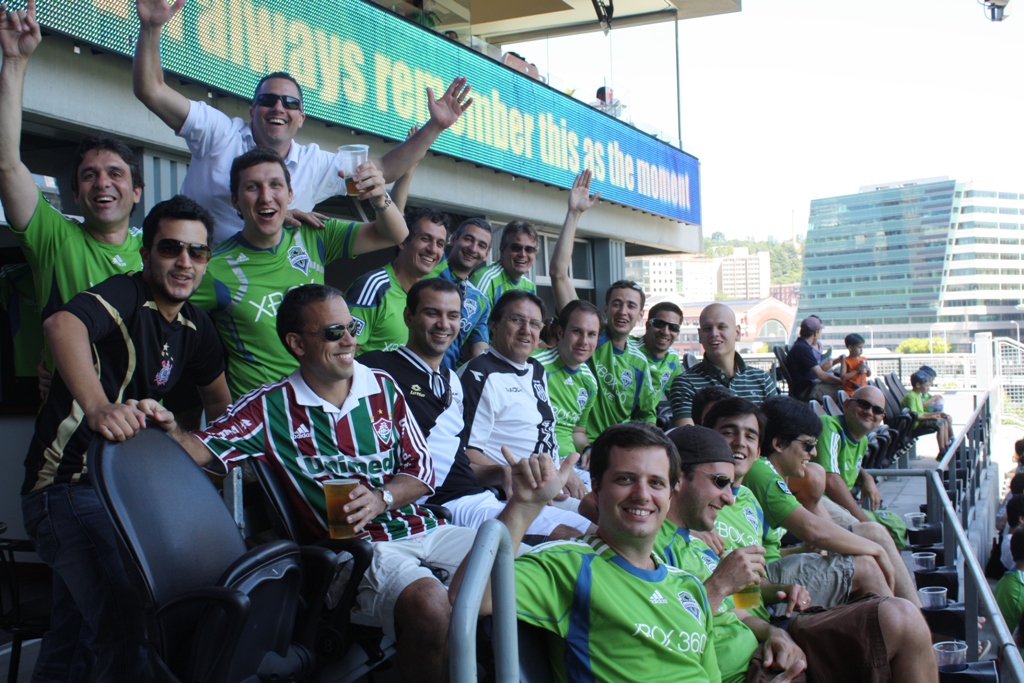
Abreu and the rest of the Wooden Legs have celebrated at each other’s weddings, watched each other become parents, and occasionally traveled together.
“Every Friday was our night, and nothing more important than that,” Abreu said. “We have girlfriends and activities. No, no, no. We have Wooden Legs for Friday night.”
Over the years, players have come and gone, either moving away or hanging up their cleats due to injuries, including Abreu.
“I can’t play anymore. I’m all broken. My knees hurt, my back hurts. I’m a little bit more, have a little bit more weight than I should have, but I still organize it,” he said.
But every week, he still sends out the message in the WhatsApp group asking who is in for Friday. From the response, he builds three balanced teams.
“Always Brazil, which is yellow. Always a blue team. So we call Italy, or we call Uruguay. And always a red team, which is called Portugal or Spain,” Abreu said.
Abreu makes a game schedule: 12 games that are each seven minutes. He tracks the scores and goal scorers. The number of stats he’s collected over the years is countless. He muses that someday maybe he’ll be able to analyze the numbers to uncover some cool patterns. For now, it’s just for fun
As the organizer of these Friday nights, Abreu knows everyone and the playing style they bring to the field.
“They all bring whatever they brought from playing as a kid. In Brazil, there is a lot of futsal because we play on cement and small spaces,” Abreu said. “The guy with the beard, we call him ‘Beard,’ he totally has the futsal style.”
Futsal is a version of soccer played on a smaller hard court instead of grass or turf. Abreu explained how they tend to hold the ball in one-on-one situations and use the bottom of their foot, looking for creative options.
“Bruno,” Abreu said. “It’s amazing how good his kick is.” Then there’s Bajo, who Abreu says is super fast. And Mano, whose body can’t seem to keep up with his mind, Abreu notes, like the rest of them, he’s gotten older and a little slower.
Most have jobs in tech. That’s how they know each other. There’s a VP of Microsoft, another from Expedia, and others work at Starbucks corporate and Meta. Of course, there are exceptions. Roger is a professor at the University of Washington and Donny has his own cleaning business.
Carlos Figueria stops by on this particular night even though he isn’t playing. For him, Wooden Legs is his community. Like Abreu, he came to Seattle from Brazil not knowing anyone and found the group through word of mouth.
“My family is back in Brazil,” Figueria said. “Anytime we move to another place, we had to find another family. … I have several families here, this group is one of those.”
Lehman is another player who didn’t play that night. He’s almost 70, but still plays soccer three times a week. He remembers growing up in Ghana playing pick-up every day.
“Boy, we played a lot and I think that that has got to do with my longevity,” Lehman said.
Wooden Legs games are quick and the pace depends on who is on the field. Time is kept on the scoreboard and a buzzer signals the end of each match.
Once they take off their cleats, they walk over to the cafe and snack on popcorn, teasing each other as they rehash plays, discuss the latest Premier League or La Liga news, or catch up on life if they haven’t seen each other in a while.
“At the end, eventually you get there. But what are you going to base your life on? Who’s going to help you when you’re there?” Abreu said. “The best is to have friends. And Wooden Legs provided really strong friendships for life.”