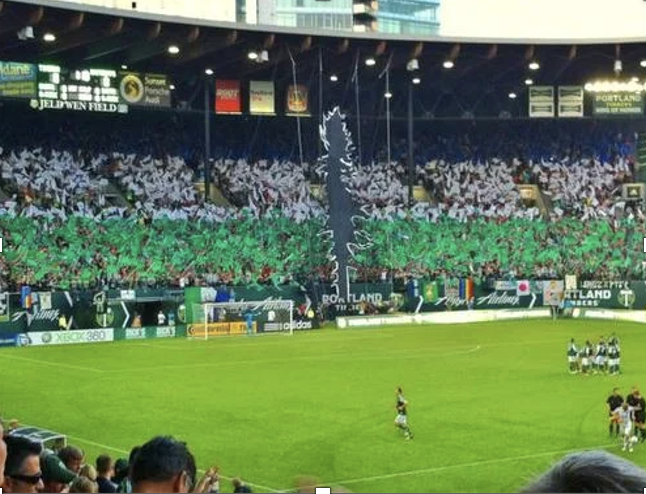
When Donald Trump was reelected president in 2024, progressives in the Pacific Northwest floated the idea of breaking off from the United States and joining with people north of the border to form a new nation.
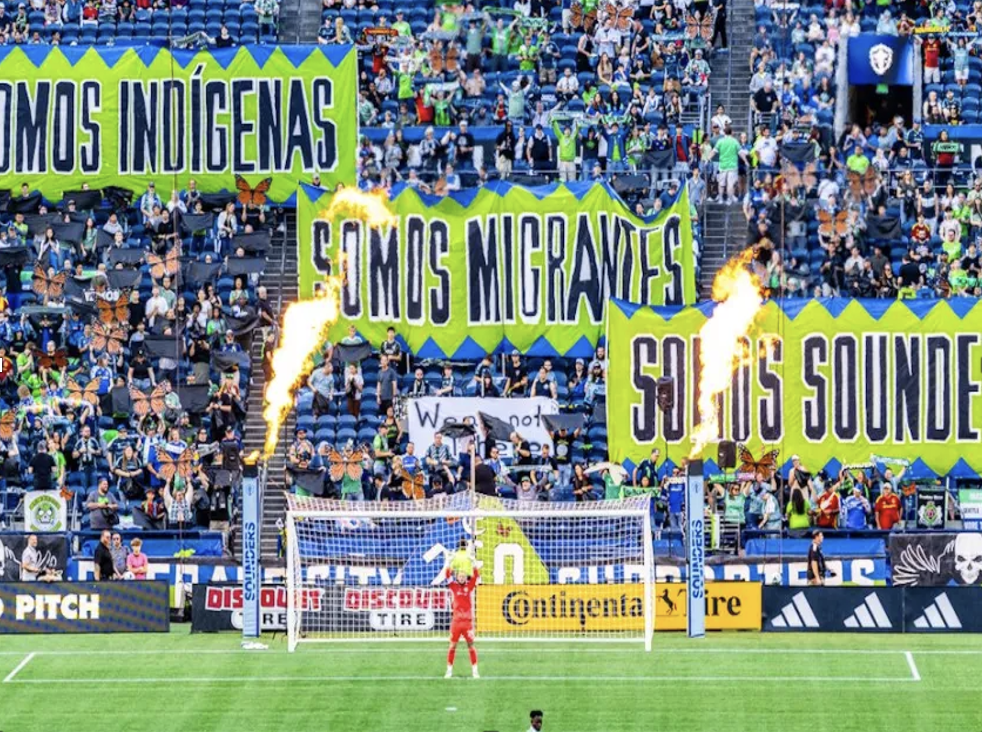
That idea reflects a deep connection between the people of British Columbia, Washington and Oregon. That camaraderie is particularly strong among fans of their soccer teams, with the three men’s teams – the Portland Timbers, the Seattle Sounders, and the Vancouver Whitecaps – competing each year for their own unique trophy.
Four characteristics make what is called the Cascadia Rivalry unique:
- The rivalry involves three teams, not two.
- It is defined by a bioregion rather than a city or a nation.
- The competition crosses an international border.
- The winner of the annual competition among these teams – known as the Cascadia Cup – is awarded not by a league, federation, confederation or FIFA, but by the supporter groups themselves.
That alone is enough to make their association dating back 50 years globally unique, but there’s a fifth element: the supporters’ commitment to work together to promote anti-fascism and anti-racism, on and off the field.
“We are rivals but at the same time there’s more important things than rivalry… and that’s the rights of supporters, the right to show that we do care about human rights,” said Fernando Machicado of the Timbers Army.
In 2019, nearly a decade after the three teams had joined Major League Soccer, fans and teams came together to protest new league policies forbidding political signs and messages inside stadiums.
The region is politically, economically and culturally dominated by the cities that run along the I-5 corridor up to Vancouver, B.C. The three cities and their states or province are also among the most progressive in both nations and have been at the forefront of advocacy for environmental protection, same-sex marriage and LGBTQ+ rights, cannabis legalization, restorative justice and other progressive causes.
In contrast to the region’s progressive cities, its rural areas include some strong white supremacist movements that have evolved more recently into support for proto- and neo-fascist groups such as the Proud Boys, Patriot Prayer, and the Three Percenters.
The Cascadia region also has a long history of racial exclusion, tracing back to at least 1844, when the Oregon Territory, which included the land that became Oregon and Washington, passed its first Black exclusion law. This history sometimes complicates the progressive sports culture cultivated by supporters of these three teams, and pushback from conservative fans is common. In spite of this, the supporters groups have continued to work, both independently and in collaboration with each other, for social justice advocacy.
The Cascadia Cup was created in 2004 by the three major supporters groups to “amplify the Pacific Northwest regional rivalry,” according to the Cascadia Cup website. At the time, all three teams played in the A-League, which was the second division in the U.S. professional football hierarchy.
The Sounders joined MLS in 2009 and the Whitecaps and the Timbers followed in 2011. As the three teams have seen significant success in that bigger arena – a Cascadia team played in every MLS Cup between 2015 and 2021, with Seattle winning twice and Portland once – the Cascadia Cup has lived on.
A two-foot-high silver cup is awarded to the team that secures the most points in regular season matches between Cascadia teams. The supporters groups organize the rules of the competition, created and financed the trophy itself, hold the trophy between seasons, and traditionally celebrate on the field with the players following the awarding of the cup each year. Vancouver has won eight times, including the most recent edition in 2025; Seattle has won seven times and Portland six.
The future of the cup could be in danger, however, as the Whitecaps’ financial challenges, along with an expiring lease for their arena, BC Place, has engendered fear of a potential move to Las Vegas.
The connections between supporters groups and broader politics is not unique to Cascadia in global football. For example, the Basque and Catalonian regions of Spain are known for their separatist left-wing politics, frequently mirrored by their football teams, Athletic Club and FC Barcelona.
“It goes outside of soccer, because you have to protect your community,” Fernando of the Timbers Army said of the Cascadia Rivalry. “You’ve got to show that you’re not going to tolerate that hate in any form, or any sort of discrimination. And I think that’s what bonded us the most.”
The most visible manifestation of these themes came in 2019, when MLS updated its “Fan Code of Conduct.” The new policy prohibited “displaying signs, symbols or images for commercial purposes or for electioneering, campaigning or advocating for or against any candidate, political party, legislative issue, or government action” inside MLS stadiums.
The league’s new policy was interpreted as being at odds with the Timbers Army and the Emerald City Supporters, because both groups had made very large Iron Front flags. The antifascist symbol of a circle with three arrows pointing southwest dates back to Germany’s Weimar Republic and had been a regular part of their supporters section at home matches.
For Timbers Army leadership, displaying the Iron Front, often accompanied by the slogan “Football Not Fascism,” defined the group’s identity. They say including the symbol in an overarching ban on political signage was a clear violation of free speech. And they see the commitment to antifascism as a human rights stance, not a political one.
The Emerald City Supporters also have a long tradition of flying a banner at matches that reads “Anti-Fascist, Anti-Racist, Always Seattle.” This slogan had run afoul of MLS’s earlier ban on political flags during the 2017 Western Conference semi-finals at BC Place,, when MLS ejected two Seattle fans for displaying the flag.
The league’s newly revised code of conduct was used to ban these flags and other antifascist slogans from all games at all MLS stadiums. The Sounders’ front office then issued a statement explaining the new league policy that listed antifascist groups alongside the Proud Boys and other right-wing extremists. The Emerald City Supporters fiercely objected to the Sounders’ front office inferring that moral equivalency, and the office later apologized.
The Timbers Army and the Emerald City Supporters organized a collective response. On Aug. 23, 2019, during a derby match in Portland, the groups united in 33 minutes of total silence to begin the match. The decision to break their silence at 33 minutes was a nod to the Iron Front’s origins, as the Nazi party forcibly disbanded the group in 1933.
Normally supporters groups provide the match’s call-and-response energy of chants, songs and banners, so their complete silence at the beginning of that match generated an incredibly eerie atmosphere. The Timber Army’s Jesse Wagner described how strange it was to be able to hear the players on the field. Players for both teams endorsed the protest by holding “anti-fascist, anti-racist” pennants during the pre-match photo. Sports scholar Jules Boykoff and progressive sports journalist Dave Zirin subsequently described how “a soccer game [became] an anti-fascist demonstration.”
The ban on political banners extended to supporters’ clothing. Seattle-based graphic designer Likkit Pocinwong created T-shirts to circumvent the ban, depicting an altered version of the Iron Front symbol in which the arrows were replaced with coniferous trees and the circle contained blue, white, and green horizontal stripes – all iconography borrowed from the Cascadia flag. Pocinwong’s T-shirt has been purchased by hundreds of supporters of all three Cascadia clubs and remains one of his most popular designs.
Protests against the policy spread across the league and continued in Cascadia. During a Sept. 15, 2019, match against the New York Red Bulls in Seattle, an Emerald City Supporters member flying the Iron Front was ejected at halftime. The majority of the supporters section walked out in solidarity, again creating an eerily silent atmosphere. Across MLS, the hashtag #AUnitedFront spread among supporters groups.
“That type of solidarity really showed the strength and the unification of supporters that, you know, we are going to fight for our rights and for the culture we represent,” Machicado said. “And then other teams started flying the Iron Front,” which they continue to do today, more than six years later.
A month after the Cascadia Cup match and nine days after the ECS walkout, MLS walked back their ban on the Iron Front symbol and reinstated the fans who had been banned from stadiums during the protest, though the language in the Fan Code of Conduct remains unchanged. Despite this, the Cascadia supporters groups continue to advance progressive political causes, from Pride displays to protests against the anti-immigration policies of the second Trump administration.
This piece is based off research by the authors, Ron Krabill and Sam Hurst, published in May 2026 in the French academic journal Football(s): Histoire, culture, économie, société under the title “‘Antifasciste, antiraciste, Cascadie toujours!’ La culture politique de la rivalité la plus influente du soccer aux États-Unis et au Canada.”